
icon icon Case Studies icon Pos Malaysia

Malaysia's First Live
Autonomous
Logistics
Deployment

A live Level 4 autonomous logistics proof of concept deployed with POS Malaysia in a real operational environment.

Proven with Pos Malaysia

In January 2026, ALS deployed Malaysia's first driverless vehicle into a live operational environment - a proof of concept on Malaysian grounds that will run for 6 months.

Partner

Pos Malaysia

Location

Pusat Mel Nasional (PMN), Seksyen 21, Shah Alam, Selangor.

Technology

Zelos Z10 Level 4 (self-driving), fully electric

Payload

1,500 kg

Cargo capacity

10m³

Objective

icon

Evaluate the usability, safety, efficiency, and sustainability of a Level 4 autonomous electric vehicle in real logistics operations.

icon

Assess how self-driving technology integrates into an existing transportation and operational network (Including round the clock deployment, on demand dispatch during unplanned schedule and handling of fragile & high value asset).

icon

Support POS Malaysia’ Net Zero 2050 goals through a fully electric mode of transport.

How it was tested

The vehicle ran a fixed, repeatable route within a closed operational environment, which was a point-to-point pallet transfer across at least two daily shifts. Every run was tracked in real time through onboard lidar, traffic-light and surround-view cameras, and a live monitoring dashboard overseen by the operational control team.

What We Achieved Together

1,000+ km
Distance crossed
750+
Test trips
250+
Live trips
> 400
Pallets processed
23 km
Average daily mileage
0.68 tCO₂e
Emissions avoided
0
Accidents and/or incidents

Results are as of April 2026

ALS' driverless vehicle proved these key behaviours in the field:

01 Correct yielding behaviour — the vehicle allowed opposing vehicles to pass before proceeding
02 Consistently chose the shortest (And safest possible) mapped route
03 Automated parking adjustment when a designated parking area was occupied
04 Self-assessed and overtook safely when sufficient road width was detected
05 Dynamic speed adjustment based on surrounding road conditions
06 Detected obstacles and pedestrians and recalculated its route in real time

WHAT THIS MEANS

A driverless RoBovan operating in mixed-traffic conditions within a private compound demonstrated how it can operate in real-world Malaysian road conditions, where split-second decision-making and adaptability are mission critical for autonomous logistics.
Case Studies

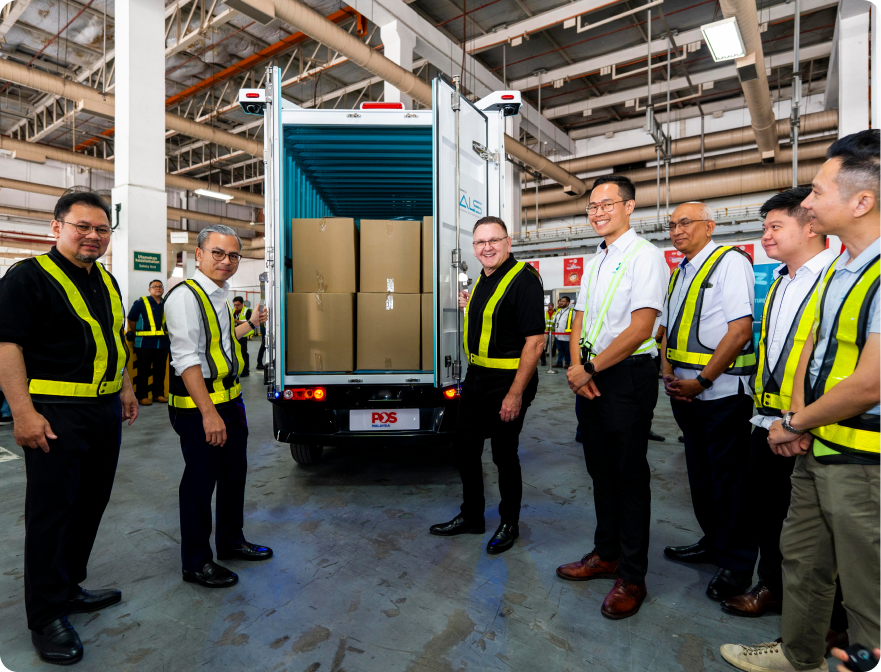
Alan Chong, Managing Director of ALS, YB Dato’ Fahmi Fadzil, Minister of Communications, Ken Lok, Founder of ALS, Tan Sri Syed Faisal Albar, Chairman of Pos Malaysia, Charles Brewer, Group Chief Executive Officer of Pos Malaysia, Datuk Azman Ismail, CEO of Digital Nasional Berhad (DNB) and Terry Zhou, Managing Director of ZelosTech at the launch ceremony.

icon

“We are immensely proud to lead this transformative journey, and we are energized by the potential it unlocks for our customers and for the entire country. This is the first mile of a very long and exciting road ahead for Pos Malaysia,"

Charles Brewer
CEO of Pos Malaysia

The operational layer behind autonomous movement

01

Real-time monitoring

Every trip tracked through a live video and telemetry dashboard — vehicle status, speed, route, and alerts visible at all times

02

Dispatch and control

Routes assigned and vehicles dispatched through a purpose-built dispatch app, with remote takeover available if a situation calls for it

03

On-ground support

Local ALS team managing day-to-day operations, troubleshooting, and reporting — not a remote vendor relationship

04

Continuous tuning

Operational data from every trip feeding back into route and behaviour refinements over time

05

Built-in safety protocol

In an emergency, the vehicle automatically reduces speed to below 5 km/h before coming to a full stop, and can be remotely rebooted or manually overridden from the operational control room

KEY TAKEAWAYS

Driverless does not mean human monitoring is not required. ALS provides an additional layer of real-time oversight, remote intervention and local support to ensure the safety of the deployment. The POC serves as a critical first step towards on-road adoption, supported by close collaboration with the ministry of transport, road transport department (JPJ) and Futurise to ensure alignment with regulatory, safety and national autonomous vehicle frameworks.

Got Questions?
We've Got You Covered.

What does "Level 4 autonomous" (L4) mean?
Level 4 means the vehicle can drive itself, start to finish, within its defined operating conditions — without a human driver needed for normal operation. A remote operator can still monitor or take over if needed, but the vehicle isn't relying on one to function. This is distinct from Level 5, which would mean full autonomy under any condition, anywhere but L5 has not reached commercial deployment. L4 is the level proven vehicles actually operate at today.
Who is responsible for the vehicle's day-to-day operation?
Customers will be onboarded and trained to dispatch and use the vehicles for their day-to-day operations, while ALS continuously monitors performance, provides operational support, and uses real-world data to recommend improvements and optimise vehicle usage over time.
How does the vehicle handle unexpected obstacles?
The vehicle detects obstacles and pedestrians in its path and recalculates its route in real time, with a remote takeover option available if needed.
What safety measures are in place if something goes wrong?
The vehicle operates within a continuously monitored, controlled environment. In an emergency, it automatically reduces speed and comes to a stop, and can be remotely rebooted or manually overridden from the operational control room.
What has this deployment actually achieved so far?
Over 1,000 km driven autonomously, 458 pallets processed, and 36 consecutive days with zero accidents or incidents, based on data as of April 2026.
What kind of logistics tasks is this suited for?
The current deployment focuses on point-to-point pallet transfer within a closed environment across repeatable daily shifts — the type of high-frequency, repetitive movement common in warehouse and depot operations.
What's next for this deployment?
ALS and Pos Malaysia are progressing through phased route testing and live testing through mid-2027, expanding from controlled routes toward broader live operational deployment.
Where else can ALS autonomous vehicles be deployed?
Beyond logistics, the same autonomous platform can be adapted to move goods, materials and equipment across a wide range of industries, including manufacturing, agriculture, airports, ports, construction, mining, utilities and large industrial sites.